Arnold Schwarzenegger is set to star in a comedy titled Why We're Killing Gunther, when he should be starring in..
Storm
The year is 3021 and New York is a crime ridden cesspool of death, rape and vermin, the police as we know it has been extinct for 100 years, but in it's place a new group of vigilantes known as The Resort have guarded the new islands and the sea surrounding them for several years.. The water patrol is feared by thugs and lowlifes for it's extreme firepower and zero tolerance towards criminals. Now a new tough as nails General has been elected in charge, Bigs (Schwarzenegger), and his mission to infiltrate the main city and take it back. On the approach of an arduous fought decade he seeks to finally destroy his nemesis, Hurley Aldenight aka Steel Knuckles (the kingpin of New Hell's Kitchen) played by Stephen Lang, and dismantle his army of the Red Cross once and for all. His team, a hardened and navy seal trained; Bullets (Elijah Wood), a highly skilled martial artist and explosive deliverer; Lights (Mark Dacascos), bullseye markman and weapons expert; Sights (Christian Slater), close combat fighter and lethal knife killer; Knives (Emily Blunt) and the heavy gun enforcer; Guns (Mr. Olympia Champion - Dexter Jackson), extensively trained by Bigs in the game bunkers in advanced tactical combat and counter-strikes, now ready to take over the four armored buildings of the Red Cross, Maxwald Hotel, Union Top, Shepard's Block and the last standing skyscraper of New York; the Chrysler Building. Prepare for the thrillride of the year, violence and blood at breakneck speed, it's Arnie's comeback action role everyone's talking about.. Don't blink or you'll end up dead!
Steel Knuckles - Stephen Lang
Red Honcho - Ben Foster
Killjoy - Rhona Mitra
Mits - Iko Uwais
Bigs Mueller - Arnold Schwarzenegger
Guns - Dexter Jackson
Bullets - Elijah Wood
Sights - Christian Slater
Knives - Emily Blunt
Lights - Mark Dacascos
Rated R, for high level violence and course language.

Friday, May 13, 2016

Thursday, March 24, 2016
The LEGO Batman Movie Trailer Review
Lego Batman trailer dropped today or at least the "teaser", and it's safe to call it thoroughly unexciting and unfunny.
Take a look below and see what I mean.
-----------------------------------------------------------------------------------------------------------------------
-----------------------------------------------------------------------------------------------------------------------
The intro beatbox was obviously a bit attempt to provide humour yet it fails hard with a vengeance, hint: Humour doesn't equal namedropping slang words. Isn't any one tired of this shtick millennials keep shoehorning in? Then there's some casually mentioning of Batman and Robin in the same sentence as The Dark Knight - they really went there, and some boring arse scene where Batman is microwaving lobster that I think is supposed to be funny... Pausing for ages and then making some blip bloop sound doesn't mean funny. At least not on this planet. There is also the placement of hip hop music because it's the go-to safe crowd pleasing choice because millennials exist. On top of all this, Seth Grahame Smith obviously can't write good humour despite his best attempts so in conclusion I smell this as a stinker a mile away, and come release I believe this'll not be close to quality entertainment The Lego Movie was.
Take a look below and see what I mean.
-----------------------------------------------------------------------------------------------------------------------
-----------------------------------------------------------------------------------------------------------------------
The intro beatbox was obviously a bit attempt to provide humour yet it fails hard with a vengeance, hint: Humour doesn't equal namedropping slang words. Isn't any one tired of this shtick millennials keep shoehorning in? Then there's some casually mentioning of Batman and Robin in the same sentence as The Dark Knight - they really went there, and some boring arse scene where Batman is microwaving lobster that I think is supposed to be funny... Pausing for ages and then making some blip bloop sound doesn't mean funny. At least not on this planet. There is also the placement of hip hop music because it's the go-to safe crowd pleasing choice because millennials exist. On top of all this, Seth Grahame Smith obviously can't write good humour despite his best attempts so in conclusion I smell this as a stinker a mile away, and come release I believe this'll not be close to quality entertainment The Lego Movie was.
Saturday, October 3, 2015
Arnie Films We Missed Out On
What we could have got - Sgt. Rock (1988) - What we got - Twins (1988)

Would any Arnold Schwarzenegger fan have been disappointed by this switch of films? Even if it was so-so (which is almost unbelievable considering John McTiernan of Predator and Die Hard 1 and 3 was going to direct), it would have been another classic Arnold action film under his belt and Twins would be a script adrift for some forgettable gross out Rob Schneider flick. I'm betting it would have been better than Raw Deal, better than Red Heat, better than Red Sonja, better than End of Days and Eraser and slew of others. Perhaps if Arnold needed the money he may have gone through with it too, but as it's well documented in Arnold's book; Total Recall, he was financially well off by the late 80's and could choose to be picky about his films instead of jumping on sequels like many other action stars. I would have taken Sgt Rock over Twins and it's sappy overly sentimental third act, with it's obvious dated and cliche mismatched pairing comedy format, no slight against Arnold but they could have got any bodybuilder in the role of Julius and it'd been hardly different. In terms of films I don't mind Twins but I don't see it as anything remarkable more than say Vice Versa (1988) or other late 80's mismatched comedy movies, it may have widened Arnold's scope of acting but it's ultimately forgettable beyond Arnold being a larger than life character next to Danny Devito's mannerisms.
Never forget.
For more info visit: http://www.dammagedgoods.com/2013/04/the-way-we-werent-arnold-schwarzenegger.html - I was made aware of this project's details and sourced one photo from this website.
Never forget.
For more info visit: http://www.dammagedgoods.com/2013/04/the-way-we-werent-arnold-schwarzenegger.html - I was made aware of this project's details and sourced one photo from this website.
Thoughts and Other Ramblings: The Shitbit
So looking up retail Fitbit prices I see the Fitbit starts at $100. $100 for a glorified pedometer. Oh but it acts as a clunky dull colored wristband toooooooo. And people I know are actually paying this price by means of legitimately forking out their actual earned wages? I mean did I miss something because there must be an in-joke somewhere here I'm not aware of, like it secretly calculates how much alcohol you drink, how many times you spew or is it how much money is wasted on fad items a year.
Of course I'm well aware it measures sleep but it still doesn't make it a good purchase. There are one of two reasons people think this is normal and not a lot of to spend, they believe their Fitbit will be worth it from word of mouth/popularity and two; people have become so accustomed to over priced things they feel it's not a rip off.
Word of mouth/popularity suckers in a lot of people every year, although we all like to think we can see through gimmicks and flashy junk, people are largely gullible to advice and danoz direct type sales, without so much as any research before a purchase. With just the right amount of incentive people will buy just about anything. Whereas being accustomed to an expensive life is the traditional history and inevitability of living in 1st world countries, where if there's a way to 'overcharge 20% for immediate availability' 9 out of 10 shops will do it. Shoppers aren't happy about it but they see no alternative, of course this has changed somewhat due to shopping online but for first day buyers clearly retail shops are the only option.
People who use Fitbit claim it helps them lose weight when in reality it's just positive reinforcement that is the driving force of any change in weight. They have something that congratulates them for achieving something very small and that makes them seek to achieve much more. A shame then that electronics have replaced someones positive and supportive words of encouragement.
In summary I think it's absurd that it costs $100 for what is so very limited, sure there is other more useless tech that costs a lot more but all who pay the going price are keeping the chain of expensive stock steady and ever flowing. My advice is don't buy from companies that don't charge what is fair, get a free app that does the same thing, get the knock off that costs half, don't be suckered into thinking there's no other option.
Of course I'm well aware it measures sleep but it still doesn't make it a good purchase. There are one of two reasons people think this is normal and not a lot of to spend, they believe their Fitbit will be worth it from word of mouth/popularity and two; people have become so accustomed to over priced things they feel it's not a rip off.
Word of mouth/popularity suckers in a lot of people every year, although we all like to think we can see through gimmicks and flashy junk, people are largely gullible to advice and danoz direct type sales, without so much as any research before a purchase. With just the right amount of incentive people will buy just about anything. Whereas being accustomed to an expensive life is the traditional history and inevitability of living in 1st world countries, where if there's a way to 'overcharge 20% for immediate availability' 9 out of 10 shops will do it. Shoppers aren't happy about it but they see no alternative, of course this has changed somewhat due to shopping online but for first day buyers clearly retail shops are the only option.
People who use Fitbit claim it helps them lose weight when in reality it's just positive reinforcement that is the driving force of any change in weight. They have something that congratulates them for achieving something very small and that makes them seek to achieve much more. A shame then that electronics have replaced someones positive and supportive words of encouragement.
In summary I think it's absurd that it costs $100 for what is so very limited, sure there is other more useless tech that costs a lot more but all who pay the going price are keeping the chain of expensive stock steady and ever flowing. My advice is don't buy from companies that don't charge what is fair, get a free app that does the same thing, get the knock off that costs half, don't be suckered into thinking there's no other option.
Friday, December 19, 2014
Disappointing Games: South Park (1998)
South Park for the N64 is extremely repetitive and tiresome to play. It's a FPS built with the Turok engine but it's simply ugly to look at even with bright cartoon visuals. The sound effects from your player and enemies becomes increasingly grating to the point of rage, there's only so many times one can hear an obnoxious South Park quote and produce a smile let alone emotion of any kind. As the game progresses there's a lot walking that feels slow and aimless, and even with mildy enjoyable quirky music it feels lifeless and boring. After killing a bunch of enemies the levels are entirely devoid of life except for power ups and collectibles, I'm almost positive the music was all that kept me trucking along for a better level or some game breaking glitch that would end my suffering.
The excessive fog coverage can not be understated as it blinds you from knowing where you're going and you'll just walk around guessing which direction to take and what areas are completed. Hoping a new game mechanic will emerge or something mildy interesting will be hiding behind a distant corner. Not to be.
The character you play appears to move by floating, this is accentuated by having no sound effects of any kind as you move or climb. It's just constant silence like the deadest of nights, you're a damned ghost drifting through a snow themed polygon demo with no personalty whatsoever, apart from your character of choice yelling catchphrase after catchphrase.
You have a choice of 4 main players to choose from including Cartman, Kyle, Kenny and Stan, but there's very little difference apart from which sound bytes you want to suffer though the most. Choosing Kenny will save your patience momentarily as you guess what's he's saying, probably something far funnier than what's actually being said. The weapons are the only redeeming quality of the game as they have the most creative design with a good variety to collect and choose from. I think if this game was a 2D platformer it may have been somewhat enjoyable and not have felt so dull and a chore to play, but as it's stands 'South Park: The Game' should be highly avoided.

The excessive fog coverage can not be understated as it blinds you from knowing where you're going and you'll just walk around guessing which direction to take and what areas are completed. Hoping a new game mechanic will emerge or something mildy interesting will be hiding behind a distant corner. Not to be.
The character you play appears to move by floating, this is accentuated by having no sound effects of any kind as you move or climb. It's just constant silence like the deadest of nights, you're a damned ghost drifting through a snow themed polygon demo with no personalty whatsoever, apart from your character of choice yelling catchphrase after catchphrase.
You have a choice of 4 main players to choose from including Cartman, Kyle, Kenny and Stan, but there's very little difference apart from which sound bytes you want to suffer though the most. Choosing Kenny will save your patience momentarily as you guess what's he's saying, probably something far funnier than what's actually being said. The weapons are the only redeeming quality of the game as they have the most creative design with a good variety to collect and choose from. I think if this game was a 2D platformer it may have been somewhat enjoyable and not have felt so dull and a chore to play, but as it's stands 'South Park: The Game' should be highly avoided.
Thursday, December 18, 2014
Radical Sequel Roundup 2
Friday the 13th Part 7: Jason Park - After a number of delays the seventh entry of the film series was released in 1995 after a fitting 7 year wait, titled Jason Park, it cheekily referenced the hugely popular movie Jurassic Park which came out two years before. Kane Hodder stepped into the role of Jason Voorhees for the first time and continued on as the masked killer for three more successful movies. Set one month after the events of the Jason Lives, Jason Voorhees is set free from his underwater tomb by a dark shadowy figure and lured into the back of a elaborately built van, where he is then trapped and driven to a remote destination in the woods. Jason ultimately sets himself free by breaking down the thick steel doors and lunging out into a wooded area, where a circus tent and large amusement park glimmer off in the distance. Two guys are introduced (Scott Wolf and Chris O'Donnell) who are big videogame enthusiasts as well as two women (Holly Marie Combs and Lara Flynn Boyle) who are less than interested, it's a double date at the park and so far all four are enjoying the night. The foursome prepare to ride the popular supposedly 'haunted' attraction; Astro-Demon's Domain. Only they don't know Jason is killing the crew working the cart mechanics, and waiting on the otherside. Will Jason succeed in killing them all? Who is this dark shadowy figure who set him free and what are his plans? Part 7 was released with mixed reviews, some stated it was too self aware and too slick with modern production while others heralded it as the reinvention Jason Voohees needed.

Twilight Zone: The Second Movie - Released in 1987, the second Twilight Zone movie featured the same formula with three different stories as the first. Steven Spielberg only worked as producer for the motion picture but was stated to be very pleased with the talented list of directors chosen. Jerry Goldsmith returned to deliver a bombastic yet emotional score that reportedly exceeded Steven Spielberg's expectations.
The prologue starred Bill Murray as Dillon and Robert Englund as David, who both get stuck in an elevator together on their way to different business meetings. To pass the time they trade jokes to each other until Englund's character explains he's holding the elevator cart up with his mind, thinking it's some bizarre joke Dillon plays along until David proves it by violently shaking the cart with his mind. Englund's character offers Murray's two choices, if he can tell him a joke in 15 minutes that's so funny he laughs hysterically he will open the door and allow him to exit safely to his meeting, and he will fall to a certain death. But if he fails to make him laugh they will both fall to their death. A montage ensues as Dillon relentlessly throws joke after joke, many hand and body gestures working in unison with his exaggerated facial expressions, while sweat pours down his face and stains his shirt in pools of dark grey, until he finally delivers the kicker that sets him free and into the waiting reception. A minute later, Dillon having heard no crash, turns around and clicks the elevator button to find the elevator perfectly sound with no one inside.
The first segment was directed by Martin Scorsese, and features a mafia gang hunting down a snitch named Theo (Sean Penn) in a crime ridden part of LA. In the dark foggy hours of a mid-winter morning they hunt him down in a number of unmarked cars filled with mobsters. He decides to hide in a random underground bar nearby. At the back seating area he witnesses a news report on a TV about a bombing in Texas when suddenly he starts to experience vivid deja vu, he sees where the gang will enter from as well as where and when to leave to avoid confrontation, his deathly future becomes apparent and avoidable. Mind maps of his future slowly process through his head. As the sun begins to rise, Theo travels to a rival gang territory to hide in desperation, he starts to lose perception of what is happening now and what is minutes in the future, affecting the very fabric of his reality. Can he survive in a demented dream-like existence or is he destined for an untimely end?
The second segment was directed by Richard Donner, the story concerns a disabled young man named Marty played by Anthony Michael Hall, who is confined to a wheelchair with multiple Sclerosis and unable to speak, he strangely seems to attract bad accidents, crime and even death where ever he goes. After a number of concerning years his carer, Elisabeth Crews played by Elisabeth Shue, begins to highly worry so she takes him to a number of appointments with authorities and brain thought specialists to determine why, but all of them come up empty handed until one late night in a backend of Chinatown. This is where she encounters a shop owner named Samuel Sun (James Hong), an advanced demonologist and self-proclaimed 4th dimension traveler. He says the young man she cares for actually is a sinister being called The Shan Kin that travels on the otherside of time and space, and can steal her very soul if it feels any danger. Sun explains she must travel with him to the 4th dimension where they will fight Shan Kin and vanquish it down to the darkgates, the unwavering space of eternal limbo. Will Elisabeth believe Sun's wild story and venture beyond? Will she save Marty or is all too late?
The third segment was directed by Joel Schumacher, it starred Michael Douglas as Doug White and Linda Fiorentino as Pam White, the two actors played a married couple relaxing on holiday on a secluded beach in Mombasa. After some hours drinking champagne and tanning in the sun they wake to notice their waiter is missing, so Doug reluctantly goes to investigate behind the bar, only to see it cleaned bone dry. The two decide to pack up and head to their room for dinner but are both hit with a thick coverage of leafy plants that greatly slow them down on their way, they almost feel lost before finally making their exit to a suddenly empty hotel. The two question if there was a severe storm warning they missed or perhaps a bomb threat, but conclude they were only asleep for a brief moment and someone would have told them. The two search for many minutes and eventually decide to leave the hotel only to find more thick leafy plants blocking the way. It seems impossible to leave, so thoroughly exhausted they turn back for now to try again later. As the two walk back past the bright blue pool, Pam notices in the distance a figure moving in the garage window, she runs over to the shed to ask for help but is shocked and taken aback to see her husband Doug killing her with an axe. "What is it, honey? What do you see?" As Pam turns around to see her husband still next to the pool and completely oblivious.

The prologue starred Bill Murray as Dillon and Robert Englund as David, who both get stuck in an elevator together on their way to different business meetings. To pass the time they trade jokes to each other until Englund's character explains he's holding the elevator cart up with his mind, thinking it's some bizarre joke Dillon plays along until David proves it by violently shaking the cart with his mind. Englund's character offers Murray's two choices, if he can tell him a joke in 15 minutes that's so funny he laughs hysterically he will open the door and allow him to exit safely to his meeting, and he will fall to a certain death. But if he fails to make him laugh they will both fall to their death. A montage ensues as Dillon relentlessly throws joke after joke, many hand and body gestures working in unison with his exaggerated facial expressions, while sweat pours down his face and stains his shirt in pools of dark grey, until he finally delivers the kicker that sets him free and into the waiting reception. A minute later, Dillon having heard no crash, turns around and clicks the elevator button to find the elevator perfectly sound with no one inside.
The first segment was directed by Martin Scorsese, and features a mafia gang hunting down a snitch named Theo (Sean Penn) in a crime ridden part of LA. In the dark foggy hours of a mid-winter morning they hunt him down in a number of unmarked cars filled with mobsters. He decides to hide in a random underground bar nearby. At the back seating area he witnesses a news report on a TV about a bombing in Texas when suddenly he starts to experience vivid deja vu, he sees where the gang will enter from as well as where and when to leave to avoid confrontation, his deathly future becomes apparent and avoidable. Mind maps of his future slowly process through his head. As the sun begins to rise, Theo travels to a rival gang territory to hide in desperation, he starts to lose perception of what is happening now and what is minutes in the future, affecting the very fabric of his reality. Can he survive in a demented dream-like existence or is he destined for an untimely end?
The second segment was directed by Richard Donner, the story concerns a disabled young man named Marty played by Anthony Michael Hall, who is confined to a wheelchair with multiple Sclerosis and unable to speak, he strangely seems to attract bad accidents, crime and even death where ever he goes. After a number of concerning years his carer, Elisabeth Crews played by Elisabeth Shue, begins to highly worry so she takes him to a number of appointments with authorities and brain thought specialists to determine why, but all of them come up empty handed until one late night in a backend of Chinatown. This is where she encounters a shop owner named Samuel Sun (James Hong), an advanced demonologist and self-proclaimed 4th dimension traveler. He says the young man she cares for actually is a sinister being called The Shan Kin that travels on the otherside of time and space, and can steal her very soul if it feels any danger. Sun explains she must travel with him to the 4th dimension where they will fight Shan Kin and vanquish it down to the darkgates, the unwavering space of eternal limbo. Will Elisabeth believe Sun's wild story and venture beyond? Will she save Marty or is all too late?
The third segment was directed by Joel Schumacher, it starred Michael Douglas as Doug White and Linda Fiorentino as Pam White, the two actors played a married couple relaxing on holiday on a secluded beach in Mombasa. After some hours drinking champagne and tanning in the sun they wake to notice their waiter is missing, so Doug reluctantly goes to investigate behind the bar, only to see it cleaned bone dry. The two decide to pack up and head to their room for dinner but are both hit with a thick coverage of leafy plants that greatly slow them down on their way, they almost feel lost before finally making their exit to a suddenly empty hotel. The two question if there was a severe storm warning they missed or perhaps a bomb threat, but conclude they were only asleep for a brief moment and someone would have told them. The two search for many minutes and eventually decide to leave the hotel only to find more thick leafy plants blocking the way. It seems impossible to leave, so thoroughly exhausted they turn back for now to try again later. As the two walk back past the bright blue pool, Pam notices in the distance a figure moving in the garage window, she runs over to the shed to ask for help but is shocked and taken aback to see her husband Doug killing her with an axe. "What is it, honey? What do you see?" As Pam turns around to see her husband still next to the pool and completely oblivious.
Tuesday, December 16, 2014
Good Obscure or Rarely Discussed Films: Stay Tuned (1992)

Director: Peter Hyams
Starring: John Ritter, Pam Dawber, Jeffrey Jones
John Ritter plays Roy Knable, a struggling plumbing salesman who's mainly a couch potato when away from work and with the family, one day he gets an upgrade on his home television unit from a shady door salesman named Mr. Spike. This upgrade comes in the package of a new high tech satellite dish filled with strange channels that none of the big networks offer. Things take a turn for the weird when Roy and his wife Helen get sucked into the twisted world of their TV and forced to partake in a series of gameshows and obstacles with life or death consequences.Stay Tuned is a thrill ride from the get-go, it doesn't spend much time developing the characters or coming up with a brilliant set-up as say Honey I Shrunk The Kids. It instead goes for the jugular and transports you into a twisted realm of screwy comedy, of which can seem like a lost episode of Twilight Zone or Tales from the Crypt. John Ritter in my opinion was rarely better than here with his perfectly timed brand of dry comedic delivery, working in time with the films outlandish spectacle of tv show send-ups in effortless fashion.

It's family entertainment at it's finest with a sense of daring potential rarely seen, never scared to go places the MPAA would have a field day with, but always managing to have heart and importance despite it's overtly wacky tone. To put it simply it's a relic of it's time, it's when studios dared to take chances and new ideas were welcomed with dollar signs.
Much of the reason it's not highly regarded is due to it having ditched the light-hearted fluff of yesteryear and going for cleverly disguised M-rated jokes, this was of course met with disapproval by most families looking for another Hook or Mighty Ducks. Aided to that themes of Hell and Satan, with gags about murderers, death and horror movies and you've got a wild mix that was ten years ahead of it's time. Highly recommended if you like John Ritter and your PG Rated comedy with bite.
Radical Sequel Roundup 1
They Live 'Again!' - John Carpenter opts against Escape from LA to bring a sequel to his 1988 cult classic; They Live. Roddy Piper returns as John Nada and Kurt Russell co-stars as a tough as nails detective, Sam Hurt. Set after humanities first attack and imprisonment of the aliens of the first film, John Nada is cloned back to life using advanced alien technology, the only problem is.. Zodern, a very elusive mastermind alien, is doing the same thing with what's left of the alien population, and now the clock is ticking down for Nada and Hurt to hunt down Zodern and his followers before they can create an army large enough to control LA and memory-wipe the world with airborne hallucinogens. Roddy Piper delivers a heavy performance as a man forced into an unstable world on the verge of collapse while also wrestling with emotions of who he is as a clone, while Kurt Russell offers the voice of action and reason to a bluntly dismissive John Nada, the suspense ramps up as the two try desperately to catch Zodern, but nothing will prepare you for the explosive finale that several high profile reviewers including Roger Ebert say trumps the first film.
Roadhouse Las Vegas - Off of his return to cinemas with the hit movie Donnie Darko, it was a busy year for Patrick Swayze with 11:14 and One Last Dance, but he hit his final roundhouse with stellar blockbuster Roadhouse Las Vegas. The year is now 2003 and an older James Dalton is faced with the deadly choice of life in prison or operate an elite squad of bouncers at the hardest gig in town, the 15 storey Ocean Casino, where the mob and corrupt police rule and the only way to exit is in a body bag. It's down to Dalton and his two loyal friends, Cassidy Walker and Elliot Miller, to take down the special armed forces and security that control the upper floors, then the infamous and sadistic big boss, Don Hogue.
Indiana Jones and The Thorns of Helheim - The 4th entry in the popular film franchise was released in 1996, Harrison Ford decided to depart Sabrina early into production to return one last time to his undisputed role of Indiana Jones. Set in 1942 in the heart of Iceland, several feet deep beneath the surface sits the entrance to Helheim, the long since thought fictitious Hel of Norse mythology. Accidentally excavated by Indiana Jones and his team of diggers in search of a mysterious blue boat of gold, it's up to Indiana Jones and his young friend Short Round to explore the grand labyrinth-like city below. All seems promising as the two quickly return with gem-encrusted golden artifacts, until the entrance is suddenly sealed shut and with no exit it's up to the pair to continue the treacherous journey below in search of an exit. Critics and fans were predominantly overjoyed, saying it delivered the right tone with it's dark and more adult subject matter that Temple of Doom simply couldn't get right. Short Round is equal parts comic relief as he is a useful quick-thinking sidekick, with deeper emotion depth and a character arc that continues on where Temple of Doom only dabbled.
Roadhouse Las Vegas - Off of his return to cinemas with the hit movie Donnie Darko, it was a busy year for Patrick Swayze with 11:14 and One Last Dance, but he hit his final roundhouse with stellar blockbuster Roadhouse Las Vegas. The year is now 2003 and an older James Dalton is faced with the deadly choice of life in prison or operate an elite squad of bouncers at the hardest gig in town, the 15 storey Ocean Casino, where the mob and corrupt police rule and the only way to exit is in a body bag. It's down to Dalton and his two loyal friends, Cassidy Walker and Elliot Miller, to take down the special armed forces and security that control the upper floors, then the infamous and sadistic big boss, Don Hogue.
Indiana Jones and The Thorns of Helheim - The 4th entry in the popular film franchise was released in 1996, Harrison Ford decided to depart Sabrina early into production to return one last time to his undisputed role of Indiana Jones. Set in 1942 in the heart of Iceland, several feet deep beneath the surface sits the entrance to Helheim, the long since thought fictitious Hel of Norse mythology. Accidentally excavated by Indiana Jones and his team of diggers in search of a mysterious blue boat of gold, it's up to Indiana Jones and his young friend Short Round to explore the grand labyrinth-like city below. All seems promising as the two quickly return with gem-encrusted golden artifacts, until the entrance is suddenly sealed shut and with no exit it's up to the pair to continue the treacherous journey below in search of an exit. Critics and fans were predominantly overjoyed, saying it delivered the right tone with it's dark and more adult subject matter that Temple of Doom simply couldn't get right. Short Round is equal parts comic relief as he is a useful quick-thinking sidekick, with deeper emotion depth and a character arc that continues on where Temple of Doom only dabbled.
Tuesday, December 9, 2014
In Defense of The Older Action-Movie Star

You've seen it, the general negative opinion of older actors returning to their action roots, it's everywhere you look, from snooty critics to movie site comments, to the damning box office. But what is exactly wrong with actors in their 60's doing physical demanding roles?
One might say it's their appearance, that they are no longer the glorious image of strength and peek psychical fitness they once were. In this instance it seems if an actor ages they must do drama or more suitable 'old man' roles, but action stars are not forever young and truth be told most started their careers in their 30's. Most didn't have the foresight to how successful they might become. So should they therefore give up what they're good at because they don't look as youthful as they did? Frankly, it seems to be a shallow judgement any which way you slice it.
"They should age gracefully and pull away from psychical demanding roles". Why should they if they can pull off a strong role like Sylvester Stallone has shown with his later succession of films, from Rambo 4 and on, looking older but nowhere near frail or incapable of such heroic feats, then why be a negative ball and chain of such things unless you don't want to see more of their action films.
Let's take Arnold Schwarzenegger for example, as he appears to be the most strong bearer or criticism due to his age. Why is now that Schwarzenegger is receiving the brunt when comments regarding The Sixth Day in 2000 featured nothing of the sort, age wasn't a factor in the slightest degree, what happened in 13 years that grew out the public's disapproval? Could it be his time as governor, or his well publicized affair in 2012, two things that really shouldn't affect ones view of his action movies, or is the sad truth that the public simply can't separate the man off-screen from the actor on-screen? I personally think it's directly related.
This leads into the old age equation by way of mocking and ridicule, one instance of criticism (his affair) leads to another criticism (he's no longer the flawless man we grew up with) which leads to another. Age is simply one of the most obvious targets. Whether they are valid in relation to the actor's public output or not, all the faults of the celebrity are in the spotlight and are up for scrutiny.
I grew up with action heroes such as Arnold Schwarzenegger and Sylvester Stallone and it's not a mere nostalgia trip to see their new movies, it's about more quality action movies from quality action stars who have the personality as well as the muscles. Two things (despite new comers like Dwayne Johnson) that have rarely been duplicated so well. I don't see two frail actors struggling to breathe, cooped up in a wheelchair with some debilitating illness, what ever trends come or go, whether politically correct or on the fence, whether violence is in or out, I see two actors past their prime but still in top form.
 |
| Yep, still got it. |
Monday, March 31, 2014
Films That Should Be : Jumanji 2

Jumanji had all the makings of trilogy, it's hard to fathom then how a sequel was never made. The end scene of the film was clearly set up for sequel, in such a way that I wouldn't be surprised if a script was on stand-by. Besides it made a lot of money at the box-office, raking in $262,797,249 worldwide and becoming the 7th highest grossing movie of 1995, just under the marvellous GoldenEye. It received mixed reviews from critics but audience goers paid with their wallets and thought it was the best family movie of the holidays.
I personally saw it in cinemas in '95 and I enjoyed the hell out of it. When I left the cinema I day-dreamed about the possibilities of a sequel, as the ending made me anticipate one. It would surely be more extraordinary and more wild than the first, perhaps they would travel to the jungle itself? Or maybe it would be set in a desolate theme park, there were numerous doors opening in my mind. I'm sure many others thought just as myself that it wouldn't be long until a new Jumanji.
I became a fan overnight and as Christmas was only a week away my family quickly knew what to get me. Many sleepless nights later and the fateful day rolled around, I got given the official movie tie-in novel and board game. One thing I really wanted was the board game. To me as a kid it's style and design was a work or art, so I was wrapped and quite content regardless of whatever other presents I got. Now this game wasn't quite like the movie as that was wooden and this was cardboard, but it's overall effect was the same and I was happy to have it. The novel was a fun read that I'd re-read ad-nauseam just to remember every detail, until it was eventually released on cable.

Many years have now passed and Jumanji isn't the golden gem I once thought. It's not bad by any means but the CGI hasn't stood the test of time and now feels dated. Secondly some comedic parts feel too kiddy like what you'd expect from an Ernest movie, but 19 years later there's still much to enjoy.
I first expected a sequel within the coming years around '98 or so. There was rumours flying and tidbits of news circulating on Entertainment Tonight, yet sadly nothing was confirmed or eventuated. Years rolled on I'd given up hope and instead become preoccupied with Pokemon, Dawson's Creek and various cartoons including Jumanji. I definitely felt the cartoon was the best and closest to a sequel we'd get.
Why Jumanji 2 wasn't made remains a mystery, much of it's history is unintentionally or intentionally shrouded in secrecy. Zathura was the most recent link which was given the unofficial title of a sequel, yet it's merely the same author and features a board game that manifests things. The board game itself is very different to the 1995 film and most importantly isn't 'Jumanji'.

In '99 aintitcool news revealed a plot outline for the sequel which concerned The President of The United States visiting a strange shop somewhere in Europe, where he sees and buys the magical board game, perhaps as a present for his children. He takes it back to America and strikes up a game with the Vice President in the oval office. Unfortunately the President makes the same mistake as Alan Parrish and is sucked into the jungle of Jumanji, after which the Vice-President who has pesky ulterior motives, takes advantage of the situation and quickly hides the board game. Eventually resulting in him becoming President and all hell breaking loose.
I assume Robin Williams turned down the role a couple of years prior and 'Plan-B' was opted, which unmistakably sounds awful. Not only is the President unrelatable but uninteresting, cliche and way too grand, even in the adventurous spirit of the first movie. I can only hope this was a very loose plot device that would have counted for 10 minutes of actual screen time, then thankfully focused on another family. The cartoon series had much better plot potential with a hefty number episodes working flawlessly as a continuation of the film.
Ken Ralston was reportedly attached to direct, basically using the sequel as a launching pad to make Mysterious Island sometime after. Ralston has no direction to his name but a large list of visual effects supervising work on many films including Jumanji. Which in theory sounds like a great fit although by most reports he would have rushed the sequel and it would've suffered. It even got to the stage of preliminary animation before Ralston left the project, which seemed to steam from arguments with Sony, who were then in charge.
I can't say I'm sad this effort didn't get off the ground. The wrong people were involved, the plot was almost non-existent and most importantly it wasn't a continuation of the first film, but something very different and mostly tacked-on. I believe Robin Williams was a stepping-stone to a faithful new chapter that would've been true to the original while elaborating more strange characters and problems from the jungle. It's difficult to imagine that more attempts and efforts weren't made subsequent or prior.
Williams would have opted out of a sequel after '95 because he was too busy. Making 5 films a year until the turn of the millennium, It would be surprising if he even considered cramming Jumanji 2 somewhere in the mix. Williams was clearly riding the wave of success and a sequel would have been beneath him, while also unusual as he only ever returned to play Genie in Aladdin until later roles.
2005 would have been an ideal time to make a sequel as it was the ten year anniversary and Robin Williams' schedule was relatively empty with only two films to his name that year, The Big White and Robots, the latter being one he could do in his sleep. Williams would have been in his early 50's, a few years before his heart problems, and raring to have a another crack at a family comedy after a series of dark dramas and thrillers.
Zathura was also released in 2005, which maybe coincidental but to me adds weight that the ten year mark was ideal and something studio heads would have wanted. Perhaps after exhausting their efforts they settled on Chris Van Allsburg's other children's book.
Maybe it's a good thing it wasn't made but I can't help wondering what might have been if not for a few obstacles. Especially something so successful and wildly popular that it now seems odd that nothing afterwards was made. Where The Crow gets 3 sequels after the Brandon Lee's death and Jumanji can't even manage one, and there's no real reason, deliberation or explanation for fans, except a visually better looking re-boot that'll surely be a pale imitation and not nearly the same.
Wednesday, March 26, 2014
Review: Samurai Jack Episode 1 (2001)

Creator and Director: Genny Tartakovsky
Voice Actors: Phil LaMarr (Jack), Mako Iwamatsu (Aku)
Samurai Jack was an action/adventure cartoon which aired on Cartoon Network between 2001 and 2004. It was primarily about a samurai warrior that was sent to the future by a demon wizard, Aku, just moments before he was to be defeated. It's about the time-displaced samurai who adopts the name 'Jack' and his journey to find way back to his own time, to rid the world of Aku once and for all.
I remember the show fondly as a kid and tried to catch it whenever it was on TV in the early 00's, unfortunately I missed a few episodes here and there so I was never sure exactly where I was in the series. But I always liked how action was at it's forefront and it's sci-fi setting naturally stuck out to me, it's lengthy fight scenes were exciting and the blocky shaped style with it's brightly lit colours was visually splendid.
'The Beginning' is as you'd expect the very first episode, and as such it mostly serves as a origin tale. Aku is brought back to the living by a lightning bolt and eclipse, coincidentally as a young boy's dad, an Emperor, explains the history of Aku and his almost eternal past threat. Although his dad believes he vanquished him long ago with the help of a special sword crafted by three monks with mystical powers. His father tells him to 'always be alert, for the presence of evil is sometimes right behind you', just as the evil demonic wizard crashes through the roof of the palace. Almost at once his father's army attacks and shoots a thousand arrows, all of which are collected effortlessly and shot back by Aku. The little boy's father tries to grab the magical sword but is quickly stopped and held captive by Aku. All is lost but not before the father instructs his mum to protect the Prince.

The two thankfully escape by boat and travel out to a large ship, where the Prince must tearfully depart alone and leave his mum. Aboard the large ship the Prince begins his quest to fulfil his father's wishes. What follows is a fun montage that summarizes the young Prince's turn from student to warrior, he trains with gladiators, Vikings, Russian axe throwers, Mongolians, Tibetan monks and even Robin Hood. How this exactly occurs over the span of 30 years is interesting, but nevertheless our samurai emerges strong and ready. He travels to a temple in the clouds where he reunites with his mother and is given his father's sword.
At this point the Prince seeks out his home land, to deliver payback and death upon his life-long enemy. We see what was once the Prince's home has long since become Aku's desolate land, which resembles Hell in many ways, even consisting of slaves building structures and digging for jewels by the strict command of Aku minions. The minions are dressed with devil-horned hoods and red and black ninja clothes, with black whips at their side, they are eager to inflict pain for any who disobey. Elsewhere in Aku's massive cave-like fortress, the Prince's father is stuck at the bottom of a statue of Aku, where he works under the watchful eye of a tormenting minion.
The Prince arrives and quickly defeats Aku's minions with swift strikes and chops. After freeing his father, he promises him to finally vanquish Aku. The Prince charges on horseback towards Aku's tower where he calls the formidable demon out. With swift and continuos strikes and calculated blows, Aku's shape-shifting attack method proves fruitless. Each strike takes more of Aku's power until he is a just weak shadow. In a last desperate attempt to stay alive, the demonic wizard opens a portal where the Prince is flung inside and sent into the future.

In comparison to other episodes there's seems to be a general lack of humour, it's unmistakable, I suppose given it's dark subject matter and the fact we are only are just getting to know the Prince, it's to be expected. The action on the otherhand, especially the final battle between The Prince and Aku is really exciting, it makes the whole episode worth watching. It's most of all satisfying seeing our warrior finally rise to the occasion.
'The Beginning' serves as a first taste of the main characters and their world, and as such we unfortunately don't get to see the fun and comedic side of Samurai Jack. Even it's unintentional comedic pauses and sight gags aren't for show. I think the comedy is important because it breaks up the daunting violence with much-needed light-hearted humour. It's a balance that I believe wasn't crafted as well in this episode, yet I don't think it would have suited it's tone if more prominent.
Tartakovsky manages to show off his cinematic story-telling like few others. Despite simplistic drawings his inventiveness shines with creative screen layouts, such as splicing from comic book panels to traditional widescreen film, as well as epic music and sound effects of movie caliber. Samurai Jack has moments of brilliance and compared to other shows from Cartoon Network the action is jaw-dropping. Almost all cartoon shows of this era tried to shoe-horn in kid-friendly humour, whereas Jack was also serious enough that you could enjoy it as an action movie.
The two thankfully escape by boat and travel out to a large ship, where the Prince must tearfully depart alone and leave his mum. Aboard the large ship the Prince begins his quest to fulfil his father's wishes. What follows is a fun montage that summarizes the young Prince's turn from student to warrior, he trains with gladiators, Vikings, Russian axe throwers, Mongolians, Tibetan monks and even Robin Hood. How this exactly occurs over the span of 30 years is interesting, but nevertheless our samurai emerges strong and ready. He travels to a temple in the clouds where he reunites with his mother and is given his father's sword.
At this point the Prince seeks out his home land, to deliver payback and death upon his life-long enemy. We see what was once the Prince's home has long since become Aku's desolate land, which resembles Hell in many ways, even consisting of slaves building structures and digging for jewels by the strict command of Aku minions. The minions are dressed with devil-horned hoods and red and black ninja clothes, with black whips at their side, they are eager to inflict pain for any who disobey. Elsewhere in Aku's massive cave-like fortress, the Prince's father is stuck at the bottom of a statue of Aku, where he works under the watchful eye of a tormenting minion.
The Prince arrives and quickly defeats Aku's minions with swift strikes and chops. After freeing his father, he promises him to finally vanquish Aku. The Prince charges on horseback towards Aku's tower where he calls the formidable demon out. With swift and continuos strikes and calculated blows, Aku's shape-shifting attack method proves fruitless. Each strike takes more of Aku's power until he is a just weak shadow. In a last desperate attempt to stay alive, the demonic wizard opens a portal where the Prince is flung inside and sent into the future.
In comparison to other episodes there's seems to be a general lack of humour, it's unmistakable, I suppose given it's dark subject matter and the fact we are only are just getting to know the Prince, it's to be expected. The action on the otherhand, especially the final battle between The Prince and Aku is really exciting, it makes the whole episode worth watching. It's most of all satisfying seeing our warrior finally rise to the occasion.
'The Beginning' serves as a first taste of the main characters and their world, and as such we unfortunately don't get to see the fun and comedic side of Samurai Jack. Even it's unintentional comedic pauses and sight gags aren't for show. I think the comedy is important because it breaks up the daunting violence with much-needed light-hearted humour. It's a balance that I believe wasn't crafted as well in this episode, yet I don't think it would have suited it's tone if more prominent.
Tartakovsky manages to show off his cinematic story-telling like few others. Despite simplistic drawings his inventiveness shines with creative screen layouts, such as splicing from comic book panels to traditional widescreen film, as well as epic music and sound effects of movie caliber. Samurai Jack has moments of brilliance and compared to other shows from Cartoon Network the action is jaw-dropping. Almost all cartoon shows of this era tried to shoe-horn in kid-friendly humour, whereas Jack was also serious enough that you could enjoy it as an action movie.
Sunday, March 23, 2014
Dexter and It's Dull Art Direction.
As a long time fan of Dexter something that always bothered me is the art direction. When I think of a picture to sum up a 12 episode season, with all it's twists and turns, gripping action and interesting character study, I think of obvious cards that should be drawn into the equation, such as trademarks of the villain and landmarks featured throughout the season. This is just scratching the surface of a possible art direction but we are instead given bland profile shots of Dexter.


Get it? Blood, because he's a blood spatter expert. Even season 4, arguably it's finest season, can't escape the same uninspired fate.
I don't think these covers offer much beyond a superficial thought. If I didn't know, I'd think Dexter was some gleeful deranged psycho basking in blood from a fresh kill, proud of his senseless murder of innocent people. Some may argue that the subtlety and straightness of these images is the point, but I disagree when there's next to no variation. It's the same crap repackaged in a slightly different box. It's as if the thinking switch was turned off and the art designer/s settled with a random photo of Michael C. Hall, altered it's contrast and called it a day.
Now I could understand if these images were just teaser posters of upcoming seasons but they're the legitimate final stamp of the season.
And I say art direction because this plain style is across the board. Everywhere you see official Dexter themed art, whether game, novel or merch, there's next to no variation. Take a look at some items on show:


T-Shirts and Music.
One reason for this choice of art direction, of lack thereof, could possibly be because of the first two books by Jeff Lindsay that came before the tv-show, namely; Darkly Dreaming Dexter (2004) and Dearly Devoted Dexter (2005).


Possible original. Re-release with new logo but character visually different to show.
Perhaps they were trying to keep with the theme of these covers, yet novels very rarely offer much and are inherently basic. There's of course oddities such as teen orientated books, but they usually always walk a fine line between being visually striking and lacking anything beyond text. I tend to think they tried to mimic the design of the books, as the tv-show covers could easily pass off as book covers, it's hardly a stretch to envision.
The problem is they're playing it safe and simply sticking to the source material, however bare-bones it happens to be. There's plenty of room for elaboration and it's not like the fans would throw their arms in rage to a little artistic flair. There's so many possibilities that can be incorporated and shown as evidenced by the 5-issue Marvel comic series released in 2013.


Get it? Blood, because he's a blood spatter expert. Even season 4, arguably it's finest season, can't escape the same uninspired fate.
I don't think these covers offer much beyond a superficial thought. If I didn't know, I'd think Dexter was some gleeful deranged psycho basking in blood from a fresh kill, proud of his senseless murder of innocent people. Some may argue that the subtlety and straightness of these images is the point, but I disagree when there's next to no variation. It's the same crap repackaged in a slightly different box. It's as if the thinking switch was turned off and the art designer/s settled with a random photo of Michael C. Hall, altered it's contrast and called it a day.
Now I could understand if these images were just teaser posters of upcoming seasons but they're the legitimate final stamp of the season.
And I say art direction because this plain style is across the board. Everywhere you see official Dexter themed art, whether game, novel or merch, there's next to no variation. Take a look at some items on show:
T-Shirts and Music.
One reason for this choice of art direction, of lack thereof, could possibly be because of the first two books by Jeff Lindsay that came before the tv-show, namely; Darkly Dreaming Dexter (2004) and Dearly Devoted Dexter (2005).
Possible original. Re-release with new logo but character visually different to show.
Perhaps they were trying to keep with the theme of these covers, yet novels very rarely offer much and are inherently basic. There's of course oddities such as teen orientated books, but they usually always walk a fine line between being visually striking and lacking anything beyond text. I tend to think they tried to mimic the design of the books, as the tv-show covers could easily pass off as book covers, it's hardly a stretch to envision.
The problem is they're playing it safe and simply sticking to the source material, however bare-bones it happens to be. There's plenty of room for elaboration and it's not like the fans would throw their arms in rage to a little artistic flair. There's so many possibilities that can be incorporated and shown as evidenced by the 5-issue Marvel comic series released in 2013.
Landscape. Actual landscape.
Written by Jeff Lindsay and illustrated by Dalibor Talajic, the comic-book series basically encapsulates what it should be. With landscapes and more than one idea for viewers to interpret, it's the perfect balance that summarizes a series of events while still maintaining focus on the main character. The blending of images offers a deeper insight into Dexter and offers clues as to what the story inside is all about. After reading it one can reflect on the cover and know it without having to skim through or read a summary. The front cover acts as a story telling device just as the actual panels contained.
When I go to my local DVD and Blu-ray store and see Dexter covers first hand I struggle to buy a copy because I find them bland and uninspired. I'd feel right at home buying an online copy because I feel there's nothing visually significant and appealing about the containers for the tv-show. I simply don't feel I'm missing out by not having a physical representation. And it's a shame because Dexter's art design could have been so much more but it was twarted by safe bets. (Spoilers) Like the opening introduction scene that was only changed for one single solitary episode throughout a 8 season time span, or long running characters that could have been killed off for a more emotionally devastating final season, or Debra's half-baked love affair with Dexter that was ultimately written out due to fans reaction, and ultimately not killing Dexter when it could have saved an otherwise terrible ending.
Tuesday, December 3, 2013
Game: Chip's Challenge (1990)
.jpg)
Platform: Lynx, Dos, Windows
Developer: Epyx
Genre: Puzzle
Creator: Chuck Somerville
Chip's Challenge for any that are unaware was a 90's game where you played as the title character in a 2D overhead perspective, tile-based puzzle game. I first came to play it via Windows in the early 90's and became quickly hooked. It was a perfect time waster after school that I found a vastly more enjoyable alternative to Minesweeper. Part of why I liked it so much was how easy it was to learn, no instructions were needed as the brightly lit keys and chips clued the way forward. Practically any age group could play it and with many hint boxes in the early stages even the not-so-bright could catch on.
In Chip's Challenge you play as a highschool nerd named Chip McCallahan, Chip will do anything to be in The Bit Busters, a select computer club of which Melinda The Mental Marvel is leader. Judging by the cover, I guess Melinda is the object of Chip's affection but with the limited info given who knows. Melinda agrees for Chip to be a member if he can make it through her Clubhouse in one piece and collect all the computer chips. To complete a level you must collect all the chips before the time runs out, this is done by collecting keys and opening various doors, once none of the computer chips are left you stand on The Chip Socket, a dark and light blue coloured tile, and it'll transport you to the next level.
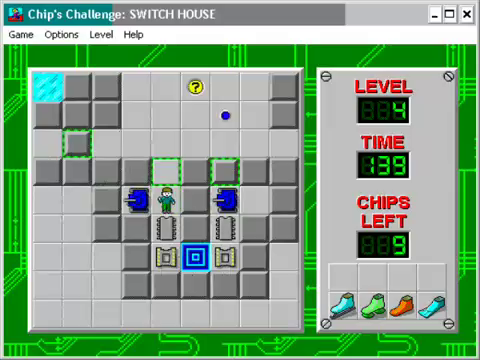
Initially the levels seem quick and easy but as you progress so does the difficulty. Trail and error is an obvious way to progress, while mentally picturing what has to be done before rushing around is also important. There's 148 levels and each has enough variety to keep the persistent gamer happy. If one seems kind of dull then the next ten will be more interesting, some may test your puzzle solving skills while others rely on fast paced action without hesitation.
You'll soon find green and black strips known as force floors as well as water traps, invisible walls and monsters, some of which need special shoes to manoeuvre past while others need fast evading. It should feel repetitive and tiresome but with an assortment of problems and special objects to acquire it stays enjoyable.
Overall it does feel rewarding when the level meter goes up and you can see the end in sight, as well as when the time meter is up and you've completed a level in record time. Besides that I'd say the summary sign that pops up when you've completed a level along with a shiny new four-letter password really reinforces that great sense of achievement. I know it might sound boring but as an old game it's simplicity comes with the territory, game designers couldn't do a hell of a lot back then.

As an old game it is clunky and the animation (or lack thereof) is jarring, even given the time you'd think they could have at least have animated Chip. But if you think of it as an alternative to the very select few puzzle games on the early Windows such as Mindsweeper, it's actually an easy stand out. It's a game you can picture as an early NES title before the system started pushing it's full 8-bit capability, it's basic but not so much as take away the feeling of being a legitimate game. There's enough difference between levels to not feel like Noughts and Crosses while enough variety of terrain to fend off growing bored from continuously collecting chips.
Sunday, November 24, 2013
Review: Poltergeist 3 (1988)

Director: Gary Sherman
Actors: Heather O'Rourke, Tom Skerritt, Nancy Allen and Lara Flynn Boyle.
IMDb
IMDb
The plot is relatively simple, Carol-Anne has been sent to Chicago to live with Daine's sister Pat (Nancy Allen), who lives with her husband Bruce (Tom Skerritt) and his daughter from a previous marriage, Donna (Lara Flynn Boyle). They all live in a luxury skyscraper with an intense fetish for mirrors, which Bruce just so happens to be the manager of. While in Chicago, Carol-Anne goes to special school that specialises in teaching gifted/intelligent children, this is where she routinely receives therapy from Dr. Seaten, who firmly denies any extraordinary encounters with Carol-Anne as merely hallucinatory. He is more or less the central antagonist and takes pleasure in his strict by-the-book assessments. Strange things begin to occur with the mirrors in the skyscraper and Carol-Anne finds herself in danger again from Reverend Kane.
The opening plays out like a John Hughes movie, and you'd be forgiven for thinking it was a sequel to Pretty in Pink if not for Carol-Anne in the picture. The family are quick-witted and play off each others responses with noticeable chemistry. We meet the other family who take Donna and Carol-Anne to their respected schools via an 'every-2-week' carpool. The mum drives Helen with her two sons Martin and Scott taking back seat, and of course her bratty little daughter Marthy at her side. I guess they picked the wrong kid for Scott though as his little sister's remark about his acne doesn't make much sense.
 |
| "Oh Scott, my knight in shining acne." Uh?" |
From there on we are introduced to Dr. Seaton, the firm sceptic of Carol-Anne's paranormal past and present connection. Even in the face of overwhelming evidence he comes up with elaborate theories to debunk what's obvious. It's hard not to hate this guy but that is good because he feeds the other characters with terrific responses and a good portion of the humour in the film is derived from his absurd explanations. He's like Walter Peck (ol' dickless) in Ghostbusters, if you didn't have him you wouldn't have the terrific comebacks/one liners and emotional mood swings his character causes.
 |
| My explanations are retarded. |
The first thing this movie does right is put Carol-Anne in a different environment, and what could be more different than the city of Chicago? Gone is the way of the cliche haunted house, in favour of something much less familiar and more modern. Added to this is the new family that surrounds her, not that the original family was problematic, but having them not be present this time around encapsulates something fresh and different. This film illustrates a progression in more ways than one. It feels like the next chapter of Carol-Anne's life, she's grown and changed as a person, her character has become smarter and more aware of herself and her surroundings.
Another thing I've noticed is the use of more unconventional scares, anything and everything can be a target, it doesn't matter if certain characters are alone or with a large groups of people. Some characters appearing to be aware of the supernatural happenings in the building while others pass by unaffected, for a change it's not always the main characters who react so strongly here. Most horror films tend to stick to the tried and tested rule of using night-time as being more suitable for scars and jumps, while in the opening of this film many of these occur during the day, this heightens the looming ever-present threat Reverend Kane exudes and adds to the uncomfortable dread Carol-Anne must feel. Eye-trickery through the use of mirrors is something this movie really drives home, although not entirely uncommon, the way it's handled here with a heavily stylistic and brightly lit approach is not wholly standard.
 |
| The use of strange happenings in mirrors is used to full unsettling effect in Poltergeist 3 |
 |
| I don't know. I could swear this is the same movie. |
I could speak highly of this film all day but it's certainly not without it faults, the score is very deliberate with amplifying the scares and can be too much at times, while the acting by the leads is generally of good quality, the rest of the cast seem to just phone it in as if reading from cue cards. Even the rerecording of dialogue seems off. As a result it tends to have moments of a less-than-memorable tv-movie/ day-time soap. I guess the fact that Gary Sherman, the director, predominantly did tv-movies kind of rubbed off on Poltergeist 3.
In regards to what others find so terrible about the movie, one thing people have a problem with is the use of a different actor in the role of Reverend Kane. I find this mostly absurd as his performance wasn't anything special in the sequel, I'd even go as far to say his role would work with a sizable number of similar frail/old actors. At this stage in the series of movies Reverend Kane is more of a boogie man than a significant personalty. He barely has any dialogue and now merely works as scary/shadowy figure. Even if you can't tolerate another actor in the role, Kane is hardly in the 3rd movie for it to be a notable concern.
In regards to what others find so terrible about the movie, one thing people have a problem with is the use of a different actor in the role of Reverend Kane. I find this mostly absurd as his performance wasn't anything special in the sequel, I'd even go as far to say his role would work with a sizable number of similar frail/old actors. At this stage in the series of movies Reverend Kane is more of a boogie man than a significant personalty. He barely has any dialogue and now merely works as scary/shadowy figure. Even if you can't tolerate another actor in the role, Kane is hardly in the 3rd movie for it to be a notable concern.
 |
| *Not a big deal. |
Roger Ebert thought the lack of police presence was a serious issue, yet he seemed to overlook how this sequel blurs the line of reality with supernatural and surreal dream-like visuals. No viewer particularly knows exactly what certain characters see as the forefront of this movie is hallucinations and false imagery, 'eye-trickery' as I mentioned earlier. When Scott comes bursting out of the pool frozen and is later found to be simply soaked in water, it's intentionally confusing because that's what the movie is going for. You're meant to second guess and determine what's real just as the characters do.
Certain characters calling out other characters names, especially Carol-Anne, is a much talked about point against this film. While I'll admit this does occur a lot, it's not something I find diminishes the story being told, in truth it's hardly as annoying as everyone claims. It's mostly a nit-pick in terms of judging the film and holds little weight.
One final point I'd like to address is the bogus notion of it having no likeable characters. Bruce for one is a kind-hearted man who truly loves Carol-Anne and will stop at nothing to protect her, the little conversations he has with her acting as a father-figure and friend are heart-warming, you'd be blind to not notice the bond the two share. When you break it down, he's a likeable guy who isn't afraid to crack jokes and keep the peace when the wheels fall off. Pat also shows motherly qualities, obviously to a lesser extent and with discomfort as she sees Carol-Anne as different and feels she was pressured into it looking after her, but she's friendly when it matters and is unafraid to voice her opinion like the strong personality she is. Donna doesn't have much of an outgoing personalty and she's a tad vain, but she's the 80's personification of cool and is always up for a bit of fun. Carol-Anne looks up to her like a sister and Donna isn't afraid to return the favour because, mischief aside, she has a good heart. It's fair to say that Dr Seaton and the rest of the cast are far from likeable but there's no denying that the characters that are close to Carol-Anne, although only briefly developed, are relatable and not in the slightest bit loathable.
In summary, while not the greatest entry in the series, it's a solid 80's paranormal horror movie with great visuals and special effects, in a style that routinely tricks the eye and is not widely common. Unlike the other entires this one has some real-world problems for Carol-Anne to overcome such as bullies, sceptics and moving on with a potential new family. Who knows what further development she'd go on to have in later sequels. While not entirely scary it does push the envelope in terms of delivering unnatural nightmare-esque visuals that creep under the skin. The opening and build up is adequate without stretching out too long, and there's enough screen time to get up to speed with all the characters before it's inevitable descent into the strange. I think the main complaint is it not living up to the first movie but if you take a step back you'll see that it has it's own bag of tricks and doesn't seek to be like the first, it doesn't rely on the source material and takes liberties in various inventive ways to add a legitimate new chapter to the series.
Subscribe to:
Posts (Atom)